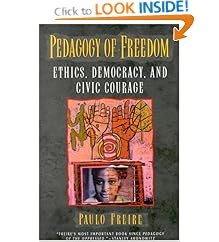
Paulo Freire (1998) wrote his last manuscript preparing for a graduate seminar at Harvard. Freire passed away before the seminar took place, and as Stanley Aronowitz explains in the Introduction, Harvard dropped the seminar when Freire the man was no longer available.
This is a text every pre-service and in-service teacher should (must) read. Freire (1998) opens the work as follows:
"Two subjects occupy me in the writing of this text. The question of what forms education and becoming a teacher, and a reflection on educative practice from a progressive point of view. By 'progressive' I mean a point of view that favors the autonomy of the students." (p. 21)
Throughout this last consideration of his life-long passion, teaching and learning, Freire offers the reader a complex and moving exploration of how we as teacher-students can address a primary concern for critical educators:
"Thus, proponents of critical pedagogy understand that every dimension of schooling and every form of form of educational practice are politically contested spaces. Shaped by history and challenged by a wide range of interest groups, educational practice is a fuzzy concept as it takes place in numerous settings, is shaped by a plethora of often-invisible forces, and can operate even in the name of democracy and justice to be totalitarian and oppressive." (Kincheloe, 2004, p. 2)
If we teach without awareness of what we believe and how our beliefs compare to what we do, we fail. Freire gives us hope.


